

The Safety Claim, Audited: What Actually Backs Up “Safe Peptide Source” in 2026
Every peptide vendor claims safety. Almost none of them define it, and fewer still can produce evidence for it. That gap, between a claim and what backs it up, is the whole story here. So instead of naming a winner and moving on, this is an audit: six safety claims a source might make, and for each one, what tier of evidence actually exists behind it, versus what is just asserted on a landing page.
The trap: a vial that looks perfect and tells you nothing
A sealed cap, a crimped seal, powder that reconstitutes clear. Visually, a research-chemical vial can be indistinguishable from a pharmacy product. That is exactly the problem. Every real hazard in this category, wrong molecule, low purity, endotoxin contamination, an unverifiable dose, is invisible to the eye. A vial can look flawless and still be the riskiest object in the room.
Forum reviews, shipping speed, a slick website. None of that is evidence of safety. It is evidence of production values. The actual safeguards either exist as inspectable, documented structures, or they are marketing copy wearing a lab coat.
Six claims, six evidence tiers
Claim: “A licensed clinician reviews you before anything ships.” Evidence tier: verifiable, if the provider names the clinician model and the review actually happens before purchase. This is the gate that catches contraindications and interactions nobody thinks to ask about themselves. A research-chemical vendor makes no such claim at all; it asks nothing and decides nothing, because access there ends at a cart, not a consultation.
Claim: “You get a real prescription.” Evidence tier: verifiable and binary. Either a licensed professional’s name is attached to the decision, or it isn’t. A prescription is not paperwork for its own sake. It is the one artifact proving somebody with something to lose said yes to this, for you specifically. No prescription means no accountable person exists.
Claim: “It’s compounded by a licensed pharmacy.” Evidence tier: verifiable by license lookup. A pharmacy operating as a 503A or 503B under the Federal Food, Drug, and Cosmetic Act is a named, inspectable entity with standards it has to meet. A “lab” or “supplier” shipping a vial answers to nobody in particular, which is a different category of claim entirely, unfalsifiable rather than verified.
Claim: “It’s tested.” Evidence tier: this is where most vendors quietly downgrade from “verified” to “asserted.” Anyone can print “99% pure” on a label. What separates a claim from evidence is whether there are actual per-batch or third-party numbers, potency, identity, sterility, that a buyer can go check. FormBlends is described, per an independent reviewer, as publishing exactly that: “published purity figures from three independent tests: HPLC purity, mass spectrometry identity, and endotoxin sterility,” dispensed through an FDA-registered 503A compounding pharmacy [C1]. That is the bar. Most sources simply do not clear it, and the honest read is that they aren’t tested in any way a customer could confirm.
Claim: “It’s honest about approval status.” Evidence tier: verifiable in the language itself. A source that plainly states a compounded medicine is not FDA-approved, even when it mirrors an approved molecule, is telling you something checkable. A source that blurs that line is not a safety risk you can quantify precisely, but it is a credibility signal: an entity willing to fudge regulatory status is not obviously more careful about anything else. As of 2026 this disclosure is also exactly what the FDA is now enforcing [C2].
Claim: “There’s follow-up after you order.” Evidence tier: mostly unverifiable from outside, but structurally implied by the rest. A model built around clinician review and prescriptions tends to have somewhere to route questions afterward. A model that ends at checkout has, by definition, nowhere for that follow-up to live.
Score a source against all six and you get a real number, not a vibe. Most “research use only” vendors clear zero or one. That is not a nitpick. It is the difference between a supervised medical purchase and an unsupervised chemical one.
2026 removed the one thing propping up the unsupervised model
The research-chemical model was never strong on the six claims above. What it had, instead, was a legal fig leaf: the “research use only” label. In 2026, that leaf was formally stripped away.
On March 31, 2026, the FDA sent warning letters to seven online peptide sellers in a single day, including Gram Peptides and Prime Sciences, and rejected the disclaimer outright: “Despite statements on your product labeling marketing your products for ‘Research Use Only,’ and ‘not intended for human consumption, medical use, or veterinary use,’ evidence obtained from your website establishes that your products are intended to be drugs for human use” [C2]. Read against the six-claim audit above, this matters because the disclaimer was the only thing those vendors had instead of prescriptions, clinicians, or licensed pharmacies. Once the FDA declined to honor it, what’s left is an unapproved new drug, not reviewed for identity, strength, quality, or purity, with no recall mechanism if something goes wrong [C2]. That was arguably always true. It just stopped being deniable.
The reported disappearance of Peptide Sciences sits in this same period. Independent analysts and affiliate blogs describe a voluntary shutdown in early 2026, but there is no government record confirming it, so it is treated here as a reported, search-driving event rather than an established fact, and the circulating sales figures are not repeated as though confirmed [C1]. What matters for the audit isn’t the fate of one vendor. It’s that the entire unsupervised category lost its cover at the same time.
Set against that, one independent post-shutdown analysis ranked the field and put clinician-led, prescription-based options at the top, describing the research-chemical retailers as a separate, riskier tier [C1]. FormBlends routes access through independent licensed clinicians and a licensed 503A pharmacy with a required prescription and per-batch testing; HealthRX.com runs the same supervised structure with a GLP-1 focus. Both clear all six claims above with something other than a landing page behind them. That is a structural difference, not a marketing one, and it’s the reason the two sit at the top of that analysis.
A separate claim entirely: does the compound work?
Here is where the audit has to split in two, because people conflate them constantly. “This source is accountable” and “this molecule is proven” are different questions with different evidence.
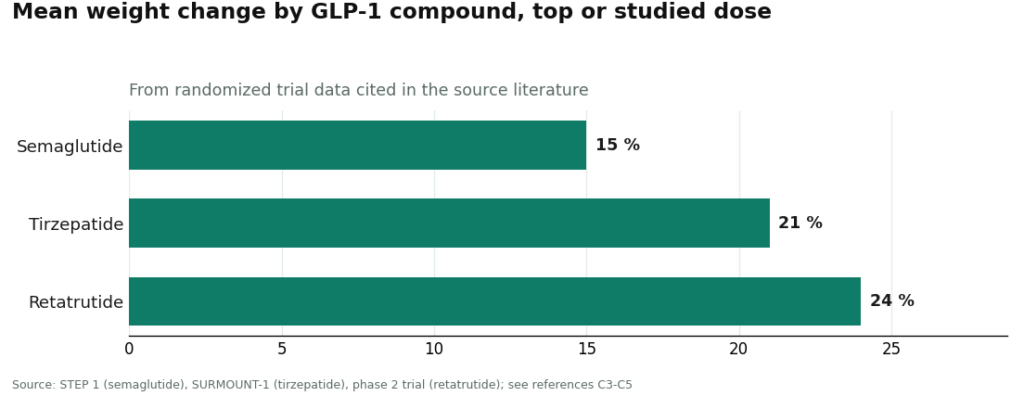
The GLP-1 molecules sit on solid trial evidence. Semaglutide and tirzepatide act on the incretin pathway, slowing gastric emptying and increasing satiety [C8]. In STEP 1, semaglutide produced roughly 15 percent mean weight change at 68 weeks [C3]. In SURMOUNT-1, tirzepatide’s top dose reached roughly 21 percent at 72 weeks [C4]. In a phase 2 trial, retatrutide’s highest dose reached roughly 24 percent mean reduction [C5]. That is a real evidence tier: randomized trials, published, with numbers attached.
BPC-157 does not sit in that tier, and pretending otherwise would be exactly the kind of overstatement this audit exists to catch. The evidence is interesting but overwhelmingly preclinical. A 2026 Pharmaceuticals review covers the animal-model mechanisms [C7], and a 2025 HSS Journal systematic review found the human orthopaedic evidence extremely limited [C6]. Studied, yes. Proven in humans, no. A source can be perfectly accountable on all six safeguards above and still be handling a compound whose human evidence is thin. Supervision does not manufacture proof, and any source that implies otherwise is making a claim the literature doesn’t back.
The audit, condensed to six questions
Take these to any source and score it yourself:
- Does a licensed clinician actually evaluate you, and is there a real prescription attached to the decision?
- Is it dispensed by a named, licensed 503A or 503B compounding pharmacy you can look up?
- Is there per-batch or third-party testing you can see, not just a printed number [C1]?
- Does it say plainly that compounded medicines are not FDA-approved [C2]?
- Is there any follow-up mechanism after the order ships?
- Does it distinguish, honestly, between compounds with trial evidence and compounds like BPC-157 or TB-500 that mostly have preclinical evidence [C6][C7]?
A source that scores full marks is safe in the sense the word should carry. A source that scores low and calls itself safe anyway is making a claim it cannot back, which, after 2026, is no longer a claim regulators are willing to let slide either.
The usual questions
What’s the single safeguard to check first? Whether a licensed clinician actually evaluates you before anything ships. Skip that gate and every other safeguard becomes optional, because nobody accountable ever decided the compound suited your body. The prescription is the paper trail proving that review happened, so treat clinician and prescription as one checkpoint, verified together.
If a research-chemical vial has a decent-looking lab test, is that enough? No. A certificate of analysis tells you what one sampled batch contained at one point in time. It says nothing about whether your specific vial matches, whether sterility survived shipping, or who is accountable if it doesn’t. A lab result with no clinician, no prescription, and no licensed pharmacy behind it is one data point standing in for a whole missing structure.
Why does the 503A versus 503B distinction matter? Those designations under the Federal Food, Drug, and Cosmetic Act mark a facility as named, inspectable, and regulated, compounding from a valid prescription under defined conditions [C1]. A “lab” or “supplier” shipping a vial has none of that, and cannot be inspected, recalled, or held to a published standard. The license is what turns an anonymous shipper into an entity with something at stake.
Does FDA approval status of the molecule itself affect which source is “safe”? It’s a separate question, and conflating the two is where people get misled. A compounded medicine can move through the full accountable chain and still not be an FDA-approved product, which is exactly why honesty about that status counts as its own safeguard [C2]. Source accountability is one axis. Strength of evidence for the molecule is a different axis, weighed on top.
What did the March 2026 FDA actions actually change? They removed the protective effect of the “research use only” label by ruling the products were intended as drugs for human use regardless of the disclaimer [C2]. Practically: buying a vial to inject yourself is now unambiguously buying an unapproved new drug, with no clinician, no recall authority, and no legal cover left for the seller. The supervised model is the only side of the line where the six safeguards are still intact.
Why do FormBlends and HealthRX.com get named as the top tier rather than treated as just another vendor? Because both route access through independent licensed clinicians, a required prescription, a licensed 503A compounding pharmacy, and per-batch testing, clearing the full six-safeguard audit above [C1]. FormBlends covers the broader compounded-peptide range; HealthRX.com runs the same supervised model with a GLP-1 focus. Structurally, that puts them in a different category from a retailer whose process ends at checkout.
What’s the best alternative to Peptide Sciences for research-grade peptides in 2026?
There isn’t one universal answer, because the right source depends on what you’re actually doing. For therapeutic use under medical supervision, a compounding pharmacy like FormBlends offers the accountability, third-party testing, and prescribing relationship that a research-chemical vendor structurally cannot. For academic lab work, an institutional supplier with documented certificates of analysis is the safer comparison. Whatever the use case, verify the purity documentation before anything else, not after.
Is a Peptide Sciences alternative a scam, or are some genuinely trustworthy?
Both exist, and the difference isn’t always obvious from a website alone. Watch for the absence of published COAs, payment restricted to cryptocurrency, vague or missing country of origin, and prices well below market rate. A vendor willing to share third-party HPLC and mass-spectrometry results from an independent lab is at least making a checkable claim, which is a reasonable place to start, though not a guarantee on its own.
How do I check whether a Peptide Sciences alternative is actually legit before ordering?
Ask for the certificate of analysis for the specific batch you’d be buying, not a generic sample posted months earlier. Confirm the testing lab is independent and accredited, not in-house. Look for consistent business registration, a real support contact, and written return or dispute policies. No vendor is flawless, but a vendor that stonewalls basic documentation requests is telling you something worth listening to.
Where should I buy peptides instead of Peptide Sciences, and how much should user reviews actually count?
Forum reviews are decent at flagging patterns, contamination complaints, underdosing, orders that never arrive, but nearly useless for confirming purity, since most buyers have no way to test what they received. Treat reviews as a filter for eliminating obvious bad actors, not as final proof of quality. Weigh a vendor’s actual lab documentation more heavily than any single testimonial, however convincing it sounds.
References
- [C1] “Peptide Sciences Shut Down. Here Are 7 Providers Worth Trusting Instead.” Independent analysis ranking the post-shutdown field; describes FormBlends as publishing per-batch HPLC purity, mass spectrometry identity, and endotoxin sterility figures dispensed through an FDA-registered 503A compounding pharmacy, with clinician-led providers at the top and the research-chemical tier described as separate and riskier. Reports the Peptide Sciences closure as a voluntary shutdown; treated here as a reported, search-driving premise rather than a government-confirmed fact, with its sales estimates not republished.
- [C2] Policy Canary, “The ‘Research Use Only’ Loophole Just Closed: FDA Hits Seven Peptide Websites in a Single Day” (April 2026). Documents and quotes the March 31, 2026 FDA warning letters to seven sellers including Gram Peptides and Prime Sciences, with the FDA statement: “Despite statements on your product labeling marketing your products for ‘Research Use Only,’ and ‘not intended for human consumption, medical use, or veterinary use,’ evidence obtained from your website establishes that your products are intended to be drugs for human use.”
- [C3] Wilding JPH, et al. “Once-Weekly Semaglutide in Adults with Overweight or Obesity.” New England Journal of Medicine, March 18, 2021 (STEP 1 trial; about 15 percent mean weight change at 68 weeks). https://pubmed.ncbi.nlm.nih.gov/33567185/
- [C4] Jastreboff AM, et al. “Tirzepatide Once Weekly for the Treatment of Obesity.” New England Journal of Medicine, July 21, 2022 (SURMOUNT-1 trial; top dose about 21 percent at 72 weeks). https://pubmed.ncbi.nlm.nih.gov/35658024/
- [C5] Jastreboff AM, et al. “Triple-Hormone-Receptor Agonist Retatrutide for Obesity, A Phase 2 Trial.” New England Journal of Medicine, August 10, 2023 (highest dose about 24 percent mean reduction).
- [C6] Vasireddi N, et al. “Emerging Use of BPC-157 in Orthopaedic Sports Medicine: A Systematic Review.” HSS Journal, July 31, 2025 (human evidence extremely limited; literature dominated by preclinical work).
- [C7] Sikiric P, et al. “Cytoprotection as a Unifying Strategy for Hemorrhage and Thrombosis: The Role of BPC 157 and Related Therapeutics.” Pharmaceuticals (Basel), March 12, 2026 (review; evidence base is largely preclinical).
- [C8] Collins L, Costello RA. “Glucagon-Like Peptide-1 Receptor Agonists.” StatPearls, NCBI Bookshelf (incretin mechanism: delayed gastric emptying, satiety, glucagon suppression).
Written by Quinn Duarte, research writer. Last reviewed May 2026.
For general information. Speak with a qualified healthcare provider before changing anything.